
Selling the company you have built is one of the most important decisions in an entrepreneur’s life. It is not just a financial transaction: it is the culmination of years of work and often a choice that touches personal as well as economic chords. That is exactly why it deserves to be approached with method, with the right information and with an advisor able to protect the seller’s interests at every stage.
In this guide we go through the main stages of a sale, from the moment the decision takes shape to the final signature, to help you understand what to expect and how best to prepare.
Where to start. We have gathered into a checklist the documents and information to prepare before presenting the company to the market: financial statements and trial balances, payment schedules, fixed assets, inventory, staff, contracts and more.
Download the checklist (PDF, in Italian)
Want to know whether your company is ready for sale? Let’s talk: a first meeting with the partners of Minerva Corporate Finance comes with no commitment.
There is no moment that suits everyone, but there are recurring situations in which a sale becomes the most sensible choice.
Generational succession is one of the most frequent: when there are no heirs interested in or ready to take over, selling to a solid partner can be the best way to secure the future of the business and its employees. In other cases the entrepreneur wants to realise the value built over time, freeing resources for new projects or for peace of mind.
Then there are market reasons. Sometimes a favourable opportunity arises, with buyers willing to pay a high value; at other times the company needs capital and skills to face a growth phase it could not sustain alone, and bringing in an industrial partner or a fund becomes the right lever.
Recognising early that you are in one of these situations lets you come to the sale process prepared, rather than chasing events.
A well-managed sale follows an orderly path. Knowing the stages in advance helps avoid missteps and keeps you in control of the negotiation.
What does a teaser look like? We have prepared an anonymous, fictional example with the same structure as those we send to potential buyers.
Download the sample teaser (PDF, in Italian)
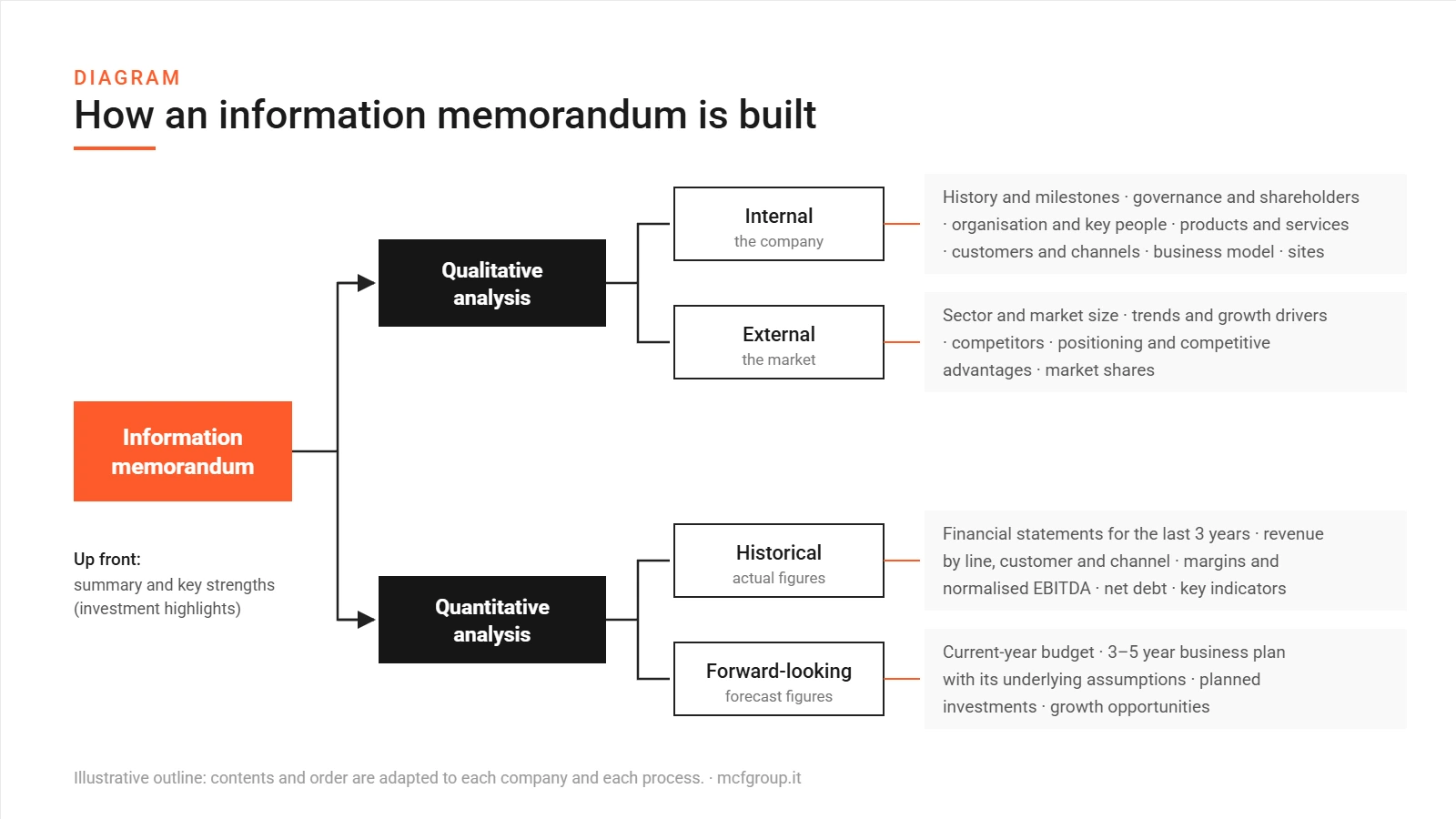
And the information memorandum? This is the typical outline of its chapters, from the company’s history to the numbers in the plan.
Want to prepare your company’s documentation? Let’s talk: a first meeting with the partners of Minerva Corporate Finance comes with no commitment.
It is one of the most frequent questions. On average a sale process takes 6 to 12 months, but the actual duration depends on several factors: the complexity and size of the company, how well prepared it is at the start, the number of counterparties involved and how quickly agreement is reached. Coming prepared, with valuation and documentation already in place, is the best way to shorten timing and reduce uncertainty.
Selling a company is something most people do only a few times in their life, while on the other side of the table there are often experienced buyers used to negotiating. An M&A advisor rebalances this asymmetry: it brings method, knows the market, manages confidentiality and holds all the threads of the process together, leaving the entrepreneur free to keep running the company while negotiations proceed.
Independence is an important added value. An independent advisor, with no conflicts of interest, works solely to achieve the best result for its client, assessing every option objectively.
Yes. You can sell a minority or majority stake, or a business unit; many entrepreneurs remain shareholders and stay at the helm for a few years.
No. The process is confidential: information is shared gradually and only with those who have signed a non-disclosure agreement. Employees and customers are usually told at signing or closing.
An industrial buyer integrates the company into its own group. A fund invests to grow the company and sell it again after a few years, and often asks the entrepreneur to stay on and reinvest.
The entrepreneur often works alongside the new shareholder for an agreed period, and part of the price may depend on future results (earn-out).
They are three different moments. The letter of intent (LOI) sets out the main terms of the deal, signing makes them binding through the sale and purchase agreement, and closing transfers ownership to the buyer.
If you are thinking of selling your business, or simply want to understand what it is worth and what your options are, we can help. Contact us for a confidential, no-obligation conversation.